Inside the Mechanics: How Video Slot Multipliers Reshape Expected Value Calculations Over Extended Play Sessions
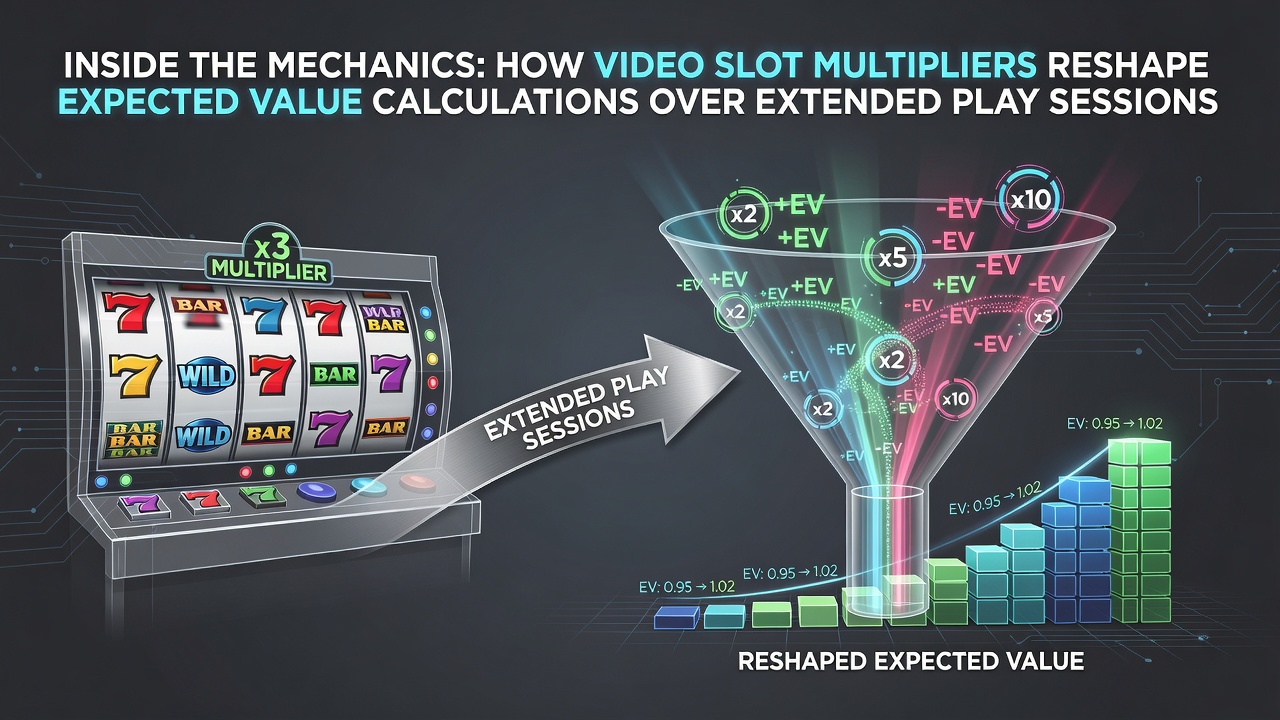
Video slot multipliers operate by scaling individual win amounts during base game spins or feature rounds, which directly alters the distribution of returns that feed into expected value formulas. Researchers calculate base expected value as the sum of each possible outcome multiplied by its probability, yet the insertion of multipliers ranging from 2x to 100x or higher requires recalibration of those probabilities because certain symbol combinations now generate larger payouts than their unmultiplied equivalents. Data from slot mathematics labs shows that when a 5x multiplier activates on a line win that normally pays 10 credits, the result becomes 50 credits, shifting the overall mean return without changing the underlying reel strip probabilities. Observers note that video slots incorporate multipliers through wild symbols, bonus triggers, or progressive features, and each implementation demands separate modeling because the frequency of activation determines the adjustment to long-term expected value. For instance, a game with multipliers appearing once every 150 spins on average contributes a measurable uplift to the theoretical return percentage only when the multiplier values and their trigger rates are factored into the paytable simulation. Studies from gaming laboratories indicate that extended play sessions spanning 10,000 spins or more reveal convergence toward the adjusted expected value, although short-term variance remains elevated due to the heavy-tailed distribution created by infrequent high-multiplier events.Core Components of Multiplier Integration in Slot Mathematics
Engineers embed multipliers into the random number generator cycle by assigning specific reel positions or bonus states to trigger them, which means the expected value formula expands to include additional terms for each multiplier tier. The revised calculation takes the form of EV equals the sum over all base wins of (win amount times multiplier value times probability of that multiplier occurring), and analysts run Monte Carlo simulations to verify the aggregate figure matches the published return-to-player percentage. Those who've examined thousands of paytable files know that multipliers attached to free-spin rounds often carry higher average values than those in the base game, creating a bimodal return structure that players encounter across sessions of varying length.
What's interesting is how scatter-triggered multipliers interact with reel weighting, because the probability of landing three or more scatters already sits at a low rate such as 1 in 200 spins, and layering a random multiplier on top further stretches the payout curve. Industry reports from the Nevada Gaming Control Board document that slot titles featuring multiplier mechanics display higher standard deviations in session outcomes compared with flat-paytable games, a pattern confirmed across multiple operator data sets submitted for regulatory review.
Adjustments to Expected Value Over Prolonged Sessions
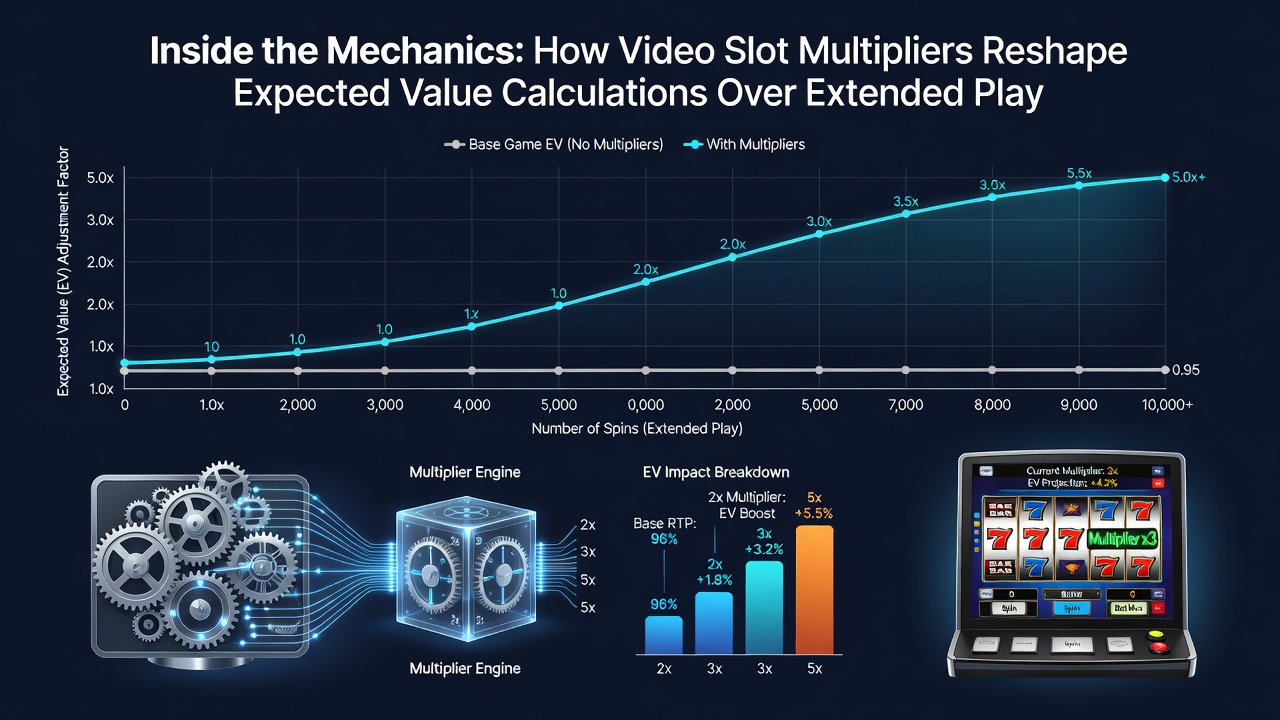
Over thousands of spins the law of large numbers still pulls realized returns toward the theoretical expected value, yet multipliers introduce skewness that delays convergence because large outlier wins occur at irregular intervals. Analysts adjust their models by separating the base expected value from the multiplier contribution, then recombine them using weighted probabilities derived from the game's symbol distribution files. Evidence from academic simulations at institutions such as the University of Nevada demonstrates that sessions exceeding 50,000 spins exhibit tighter clustering around the multiplier-adjusted mean, whereas shorter sessions display wider dispersion that reflects the bursty nature of multiplier activation.
Turns out the placement of multipliers within bonus rounds versus the base game also matters, since free-spin multipliers often stack or persist across multiple spins, multiplying the cumulative expected value of that feature by a larger factor. Data shows that when a game offers a 3x multiplier throughout a free-spin sequence triggered at a rate of once every 80 spins, the incremental contribution to overall expected value equals the average free-spin win multiplied by the trigger frequency and the average multiplier value. Those modeling these systems repeatedly observe that failing to isolate the multiplier component leads to underestimation of session volatility even when the headline return-to-player figure remains unchanged.
Practical Modeling Techniques Employed by Gaming Analysts
Analysts construct decision trees or Markov chains that track states where multipliers are active or inactive, allowing precise computation of expected value across extended sequences. Each transition probability incorporates the reel stop distribution, and the resulting matrix yields the long-run average return once solved for the steady-state distribution. Research papers published by the Gaming Research Institute in Australia highlight that games with cascading multipliers, where successive wins increase the multiplier value, require iterative simulation loops because the state space grows with each potential chain length.
One study revealed that incorporating multiplier persistence across consecutive spins changes the autocorrelation structure of returns, which in turn affects confidence intervals around the expected value estimate for finite session lengths. Observers note that operators requesting certification must submit these adjusted models to testing laboratories so that the published return percentage accurately reflects every multiplier pathway present in the paytable.
Conclusion
Video slot multipliers require explicit inclusion in expected value calculations because they modify the magnitude of specific outcomes without altering underlying reel probabilities. Extended play sessions demonstrate convergence to the recalibrated mean once sufficient trials capture the full range of multiplier frequencies and values. Regulatory filings and laboratory simulations continue to supply the data sets that allow precise quantification of these effects across different game architectures.